Showing posts with label 1/72nd. Show all posts

Saturday, March 5, 2016

Combat Patrol - France, 1940


Combat Patrol is a recent set of WWII skirmish rules by Buck Surdu.  I think they are the most innovative and easy to use set of rules for this period I have seen.  Using cards to resolve all the actions in the game keeps the focus on the game and not on rules and charts.  In my experience, after two or three activations new players are having no trouble with understanding how to play.

I had done one Combat Patrol game with my local gaming group.  They liked it, and asked for another one.  Some of the main people were out of town this week, and we only had 3 of use.  I used a scenario my brother did with another set of rules.  Always an iffy idea.  It goes to prove once again, that no scenario survives contact with gamers.

The scenario was set in France, 1940.  The French are trying to wire a bridge to blow.  There is a security force of one squad and an MMG.  Another squad plus a Panhard armored car is entering across the board because they have heard that there is a German force coming to keep the bridge from being blown.
The Germans have two squads, an MMG in a captured French truck (need to buy some German trucks) and a Pz i and a Pz II they have managed to get across the river upstream.


This is the German starting position after some activations.  The orange dice are the activation dice.  Each leader rolls a die at the start of the turn, and the dice is placed beside the unit.  Buck usually uses a more subdued die color for this.  As I wanted to take pictures, I used a brighter color.  There is an activation deck with numbered cards.  That deck is shuffled and you turn a card.  The units with that number by their leader are activated.  There is a process for deciding which unit goes first when two or more units have the same number.  This is all explained in Buck's Youtube video about the activation process.  https://www.youtube.com/watch?v=0G9UBH2ccdk

Now, as I said, no scenario survives contact with the players.  Light tanks can move quite a ways in this game.  Don, playing the Germans, proved this on his first activation when the Pz I went all the way up the road and attacked my French engineers.


He missed, but unlucky for me the same number came up the next card turn.  His Pz I was now firing 2 machine guns at close range with no moving mod.  He started picking apart my engineers before my security force could react.  I was playing the basic game, since it was fairly new players.  there are rules for reaction fire that might have affected his ability to do this.  Another lesson learned.

There were victory conditions for each side.  The French had to blow the bridge and get the engineers off the board for a major victory.  The Germans had to prevent the bridge being blown and destroy the engineers for a major victory.  The Germans did this handily.

The rules work very well.  You use the cards for moving, firing, determining if cover affects the shot, where the shot hits, etc.  You can use either the basic rules for wounds, where a wounded figure only activates on certain cards, or you can use the more detailed rules that show where the figure was hit.  The cards also do the vehicle combat.  The players quickly know what they need to hit with their units and the modifiers, which are on the cards.  It all goes very smoothly.

Buck has also done a Youtube video of how resolving hits works with armored vehicles in the game.  https://www.youtube.com/watch?v=AIFdOkNWsfo

I am enjoying these rules.  After I play a few more times I plan to take them to a con in the future to demo them.

Sunday, November 15, 2015

Combat Patrol: WWII, First Impressions

Lately I have gotten the bug for WWII skirmish.  I saw that Buck Surdu was publishing a new set of WWII skirmish rules called Combat Patrol:  WWII.  Now, I happen to think that Buck's G.A.S.L.I.G.H.T. rules are one of the best small unit sets out there, and I have played them many times.  I decided to buy a copy. 
The rules are available from drivethrucards http://www.drivethrucards.com/ .  The game uses cards for almost all randomization, so cards are needed to play.  A set of cards includes the activation deck and 4 player decks.  There is a set A and a set B.  Only one set is needed to play most games.  For large games you might need more decks for more players.  A set of 4 player decks and an activation deck is $27.  A pdf copy of the full rules is $5.
The cards are very high quality.  These are professionally produced cards with rounded edges.  They are going to last very well.  The font used on the pdf is not my favorite.  It does the job, but a more modern font would help.  Its a quibble, and possibly my own. 
The rules are well laid out.  First is a very comprehensive table of contents.  I had little trouble finding rules I needed.  The first 8 pages give the basic rules, and the next 3 pages have a sample scenario.  
I decided to set up a small scenario to try out the rules before I spring them on my local club.  Now, a disclaimer.  I don't like solo gaming.  I have never been able to get into it.  This was simply to get a better understanding of the rules.  
I thought I had a picture of the whole setup, but I guess I forgot.  The basic scenario was two French squads defending a crossroads. They were in various types of cover.  One half squad was behind a fence.  One was in a building, and the other two were in woods.
The Germans were just outside of minimum range.  They had 3 squads, and had to assault and take the crossroads.  They were only going to have 5 turns to do this, so they had to move out.  
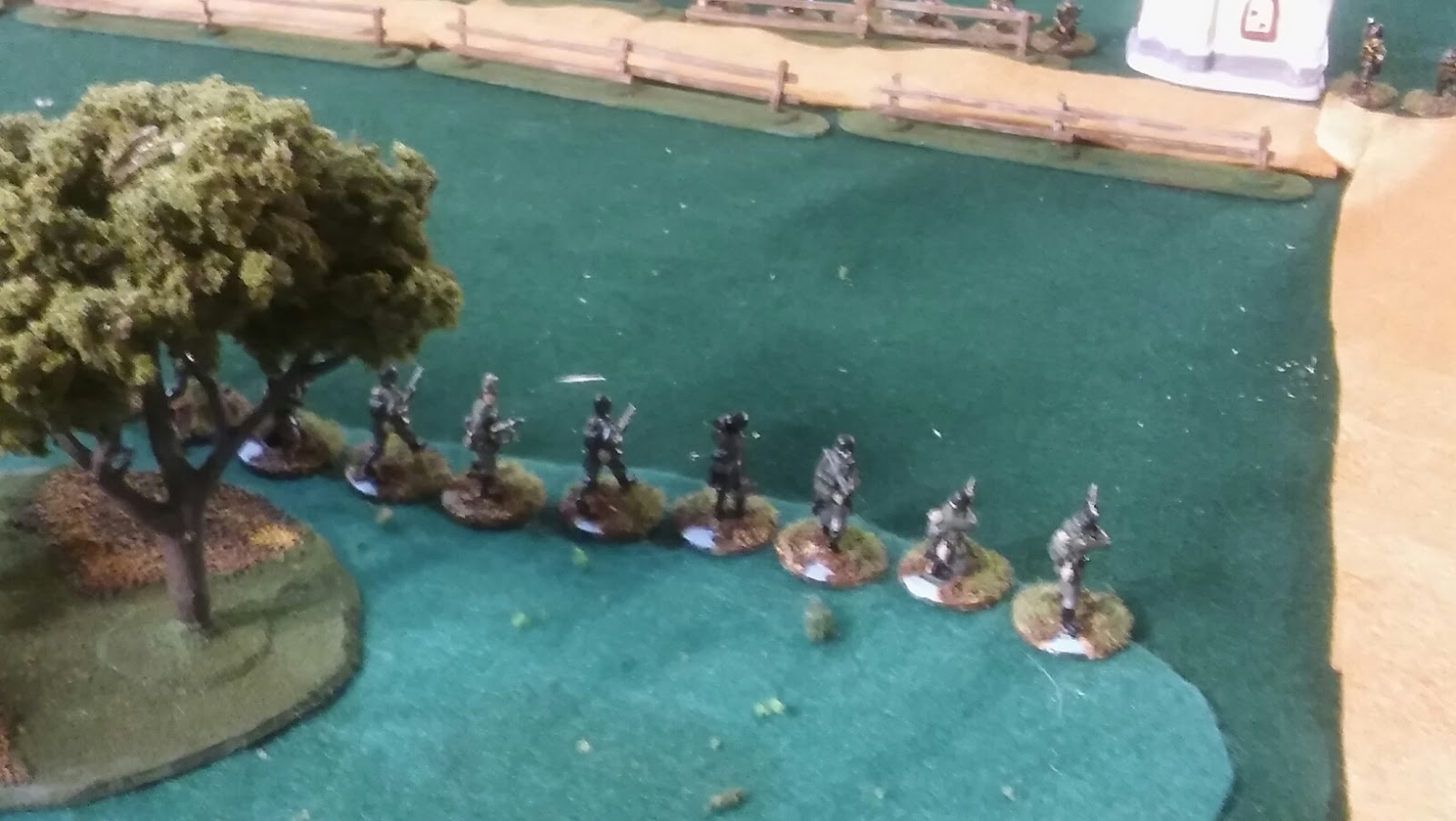
This is one squad of Germans looking across at the French.  
The way movement is handled is that each maneuver element rolls a die and that die is placed by the leader of that element.  This is done for both sides.  Then the activation deck is used.  You take a card and turn it over.  I was not using the special cards, only the number cards.  If for example you pull the card that says "2", all units that rolled a 2 for their activation are going to go.   If both sides have units with that number, you roll off to see who goes first.  (or you can pull cards, there is a randomization number on each card)  During the activation, each figure in that element can perform one action.  The actions available are move, shoot, throw grenade, recover from stun, reload, or rally.  The figures in an element do not have to all perform the same action.  
Most actions are controlled by the cards.  When you move, you pull a card from your deck and look at it.  It will  have a move distance that correlates to your Guts attribute.  A unit will not necessarily move the same distance each activation.  When you fire, all the information you need is on the cards.  You fire individually by figure.  You pull a card, and based on your accuracy, distance to the target and some other factors you might hit.  There is NO looking at tables.  You can see from the card if you hit.  If you do, you then pull another card to see what the result will be.  The card tells you the severity of the wound.  It also has different levels of cover indicated on the card.  If the target figure is in cover and that level of cover is present on the card, the wound or incapacitate is changed to a stun.  After the first couple of figures I fired, where I had to look in the rules to figure out the cover, I didn't have to check any more.  This process is VERY smooth and easy to do.  Each wound or incapacitate an element takes, a morale marker is put by the leader.  When that unit activates, the first thing you do is pull a card for each morale marker and resolve them.  Some are no effect, some are run to cover, some are remove all morale markers.  It works very fast.  
So, I did not finish the scenario.  As I said, I really dislike playing solo.  Once I established that the rules worked well, I stopped.  
Verdict, I like it.  There are rules for support weapons and tanks.  There are rules for shooting bazookas and blowing holes in buildings.  There are more complex levels of resolution of wounds if you want to do that.  (I won't be doing that)  It is a very complete set of rules, but the cards make the it easy to play.  I am going to take this to my local club to play.  

Wednesday, October 28, 2015

Arc of Fire Early French platoon and supports

My brother recently got me into Arc of Fire.  I have owned the rules for a couple of years, but I am really bad at just reading a set of rules and being able to figure them out.  I learn by doing things rather than by reading them.
So, my brother got me into 2 games.  By the second game, I was picking it up.  In my opinion, it blows any other WWII skirmish game out of the water.  Its much better than either Bolt Action or Victory Decision.
So at the second game, my brother started talking about some early war French he had bought.  He dislikes painting, and I have much more time now that I am retired.  I offered to paint them, at which point our friend Dave started laughing.  My brother bought them for me for a Christmas present, and now was getting me to paint them for him.
So, I finished them recently.


I definitely need to get a real camera instead of my phone.  We have, in 20mm, 3 squads, a command group, a sniper team, a medium machine gun, a mortar, a 25mm AT gun, and a P16 halftrack.  They will be given the baptism of fire on Saturday.

In addition I have been painting more 40mm figures for my Charge rules.  I have a squadron of cavalry (9 figures) almost finished.  Those will give me another blog post.  I have another squadron started.

Being retired, I have much more time for painting and building stuff.  I have some 20mm buildings in the works that will the subject of another post.


Sunday, March 30, 2014

Hearts of Tin

It has been too long since my last post.  I have not been gaming too much.  This changed Saturday, when Rob Baldwin and Rob Keefe came over.  This was the subject of some interest to my wife, because my regular gaming group has two guys named Jaye and two guys named Scott.  She was wondering if there were only certain names allowed for wargamers.

Rob Baldwin and I have been working on 1/72nd ACW plastic figures.  We got them cheap at a Hobby Lobby, but they appear to be closing them out.  I bought the last two packs at the local store last week.  In fact, because we used Litko bases, the bases were more expensive than the figures.

We were using Hearts of Tin, by Ross McFarlane.  His blog is Battle Game of the Month, a blog I always read when a new post arrives.  http://gameofmonth.blogspot.com/

Actually, Ross had changed the rules a couple of times since we first started on this, as we not the speediest painters around.  This resulted in changing the unit size from 5 stands to 4 on the day of the battle,


It was a meeting engagement, mostly because I didn't know enough about the rules to balance any other kind of scenario.  Control of the crossroads was the point of the battle.  The roads are just yellow felt.  I ran out of time for making the terrain, just barely finishing the fences.


We each had 2 brigades, one of three units and one of four.  They each had an artillery battery attached.  In Ross's rules you roll a die for the commander (in our case each brigade had a command figure) and that is the number of orders you get that turn.  It generally was not enough.  Each infantry unit got 3 actions it could perform. These included moving 4 inches, firing, etc.


I put the larger brigade on the right flank, which turned out to be a mistake.  There was insufficient space for them to manuever, and they were fairly ineffective till too late in the battle.

You fire by regiment.  Each one, at least for long range fire, gets one die no matter how many stands they have.  So even units that are worn down get the same fire as a fresh unit.  A 4-6 causes a hit.  The target unit rolls a die and saves on a 4-6.  An artillery unit fires the same as a regiment, although with longer range.  We did not get close enough to do close range firing/attack, where the unit throws as many dice as it has stands.  That is where the numbers will start to tell.


In the end, my left flank crumbled.  If you cause enough stand casualties that one side is to half their number of stands, then that side loses.  Rob got me to half and won the game.  All in all, a fun time.  We discussed how you could modify the long range fire so that smaller units would be less effective.  A -1 modifier per stand loss would do it, and a single stand unit could not effectively fire at long range.  There also seemed to be no special rules for counter battery fire.  Both of my batteries were destroyed by hits they couldn't save.  We weren't sure that it should be the same as for infantry fire, so we just played it like it was.

We then played another game, this time using a set of rules Rob Keefe has  been working on.  By this time I forgot to take pictures.  Rob Keefe's rules used a similar method of activating units, but there was also an overall commander who could give points to his subordinates.  It also cost a pip to move a leader.

The combat was bloodier.  You threw a die per stand, and killed on a 5 or 6, no saving throws.  The battle was very bloody, and I eked out a win at the last.

It was a good time.  Rob and Rob, who had not met prior to this game, discovered that they lived about 2 blocks apart in Lawrence, about 45 minutes from my house.

Sunday, July 21, 2013

Hearts of Tin project update

I recently finished another 2 ACW units, Confederates this time.  That brings the total to 2 Union regiments, 2 Confederate regiments, 2 Union batteries, 2 Confederate batteries, and 4 generals each.  I am going to rebase one general from each side on a larger stand with a foot figure, to be the Division commander.


My goal for the first game is 6 infantry units per side.  I have a bunch of figures in various stages of painting, so it shouldn't be too long.


Tuesday, July 16, 2013

Hearts of Tin Project - More Progress

I recently bought metal figures for the generals and artillery for our Hearts of Tin project.  I didn't like the plastic artillery, and I got figures from Musket Miniatures.  So, here are all the figures I currently have done.  Two Union units, that showed up previously, 2 Union and 2 Confederate artillery, and 4 Union and 4 Confederate generals.  Now we just need to paint up more infantry.  I have two units of Confederate infantry on bases, still needing their final touches.

The Union infantry did something I have not seen in years.  I sprayed them with Dullcote, and they frosted a little bit.  Oh well, so it goes.


And for absolutely no reason, a picture of my cat with my dulcimer, which I need to start playing again.


That was taken a few years ago.  That cat is now about 20 years old.  She still hates my wife, and has for 14 years, for no reason except that she invaded our space.  You would think she would get over it by now.

Sunday, June 30, 2013

Hearts of Tin ACW project

Recently I have gotten interested in more "old school" wargaming.  I have been reading Ross McFarlane's Battle Game of the Month blog.  http://gameofmonth.blogspot.com/

I decided I wanted to try Hearts of Tin, his old school, but ever moving target set of rules.  :)  (seriously, I like that you keep improving them, but they do change quickly)

Robb of The Army Collector and I have been painting IMEX 1/72nd scale figures for this project.  They are pretty cheap, not too bad, and paint up quickly.  (at least the way I paint)

So, I finished the first two units.


I have quite a few more figures on the way.  Usually you buy IMEX ACW figures in a box with 2 sprues of either Union or Confederate for about $9.  I found that Hobby Lobby has them in hanging bags with cardboard headers that have 2 Union and 2 Confederate sprues for $10.

I have ordered some artillery and generals from Musket Miniatures.  I didn't like the IMEX guns.